Tracing our Israelite Ancestors Story 3
Story #3 – Cadiz Spain
There is a strong connection between Israelites and Phoenicians in Spain.
According to the Bible, there is a land called Tarshish. Noah’s grandson was Tarshish.
Genesis 10:4, “And the sons of Javan were Elishah, Tarshish, Kittim, and Dodanim.”
Also 1st Chronicles 7-10 mentions another Tarshish, son of Bilhan, who was from the Tribe of Benjamin.
(Verse 10) “The sons also of Jediael; Bilhan: and the sons of Bilhan; Jeush, and Benjamin, and Ehud, and Chenaanah, and Zethan, and Tarshish, and Ahishahar.”
We know that Jonah was trying to reach Tarshish and out of the reach of God.
Jonah 1:3, “But Jonah rose up to flee unto Tarshish from the presence of the Lord, and went down to Joppa; and he found a ship going to Tarshish: so he paid the fare thereof, and went down into it, to go with them unto Tarshish from the presence of the Lord.”
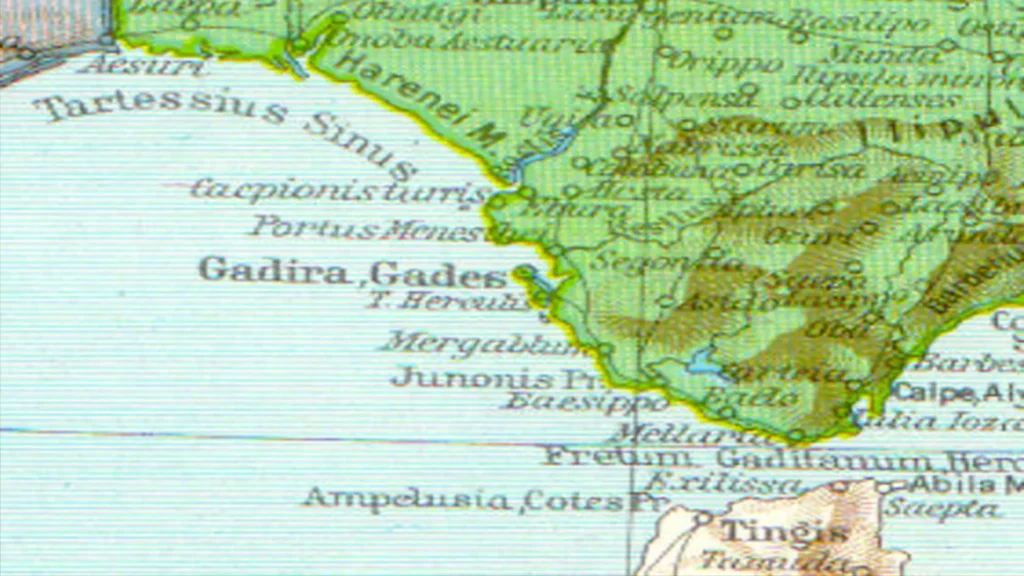
Where is this Tarshish? Study of ancient writings and maps shows that Tarshish was in southern Spain.
The Greeks called it “Tartessos”.
There is a lost ancient city near the Spanish city of Cadiz called Tartessos.
The Greeks also say that Tarshish is synonymous with southern Spain.
Theodoret, Bishop of Cyprus and Theologian, describes Tarshish’s location as being in the western part of the Mediterranean Sea.
The Bible says that the Israelite and Phoenician navies worked together.
1 Kings 10:22, “For the king had at sea a navy of Tharshish with the navy of Hiram: once in three years came the navy of Tharshish, bringing gold, and silver, ivory, and apes, and peacocks.”
The Assyrians tablets said that Tarshish is in the western Mediterranean Sea in southern Spain.
The Phoenician/Carthaginian explorer Hanno (5th century B.C.) called the Mediterranean Sea, “the Tarshish Sea”.
Tarshish and the whole of southern Spain would have had a very large Israelite/Phoenician colony population, for workers to work the local mines, port workers, merchants, and workers working the ships coming and going out of local Israelite/Phoenician established ports.
Around 1,100 B.C., the Phoenicians established a port of call in what we call today Cadiz (Spain), to use as a replenishing port to service the tin trade from Cornwall England to eastern Mediterranean Sea ports.
Cádiz is often regarded as the most ancient city still standing in Western Europe.
Cadiz, back then, was called, “City of Gad”. Gad being one of the 12 Tribes of Israel. Gad was the 7th son of Jacob/Israel. The city of Cadiz coat of arms, still to this day, says, in Latin, “Fvndator Gadium”, or the “City of Gad”.
(Notice the City of Cadiz coat of Arms has 2 Red Lions of Zara with Hercules meaning Royalty!)
The City of Gad was also known as Gades or Gadeira.
Gades means “House of the Gads” and Gadeira, meaning “Land of the Gads”.
On ancient maps, the Strait of Gibraltar was called the “Strait of Gadium”; and where Cadiz is, the bay was called, the “Bay of Gad”.
Gaud is also another name for Gad. There are 7 rivers in southwestern Spain that are named after the Tribe of Gad.
Other Atlantic Israelite/Phoenician ports include Lisbon and Porto in Portugal. Penzance in Cornwall England being the main tin export port for the Phoenicians. Penzance means “Port of the Phoenicians”.
The town next to Penzance in Cornwall is called to this day by its Hebrew name of “Mara Zion”.
Both Penzance and Mara Zion were also established around 1,100 B.C.
Israelites and Phoenicians used the City of Gad as their main port for centuries as a stepping stone for colonization of the British Isles, trade and commerce to England, Ireland and the rest of Europe.